5 Essential Steps to Master SHRM CP Situational Questions
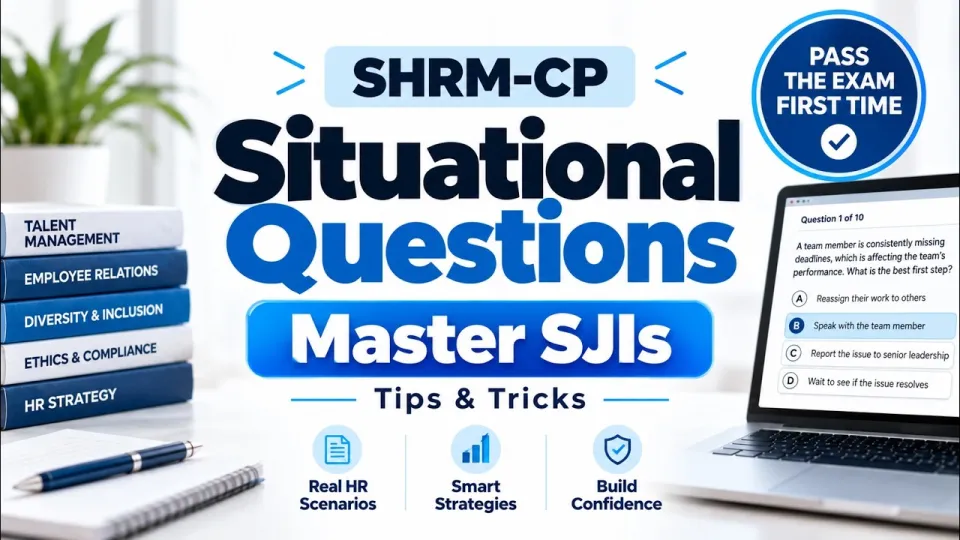
Video: SHRM CP Situational Questions (SJIs) | TIPS TO PICK THE RIGHT ANSWER
· based on the channel PrepSolution
Situational Judgment Items (SJIs) in the SHRM CP exam challenge candidates to choose the best response among multiple reasonable options in HR scenarios. To excel at SHRM CP situational questions, it’s essential to apply a structured approach that evaluates each answer against key criteria and avoids common traps. This article outlines five essential steps to help you pick the right answer confidently and improve your exam score. For additional practice, you can access free SHRM CP practice questions at PrepSolution Free SHRM-CP Practice Questions.
Understand the Question Type: First Step vs. Most Effective Action
SHRM CP situational questions often ask for either the "next step" or the "most effective" action to resolve a problem. Identifying this distinction is crucial:
- First Step: The question requires the initial action to take in a sequence.
- Most Effective Action: The question wants the best overall solution to address the situation.
Misreading this can lead to choosing premature or irrelevant answers. Carefully note wording such as "first," "immediately," or "best way to handle."
Apply the Five Decision Checks to Each Answer Choice
To evaluate options thoroughly, consider these five decision checks:
- Facts: Does the answer align with the scenario details without assumptions?
- Policy and Law: Is the action compliant with company policy and legal requirements?
- Appropriate Escalation: Does it involve the right level of authority without over- or under-escalating?
- HR’s Role: Is the response within HR’s responsibilities rather than overstepping?
- People Involved: Does it consider the impact on all relevant stakeholders?
Testing each answer against these checks helps eliminate incorrect or less suitable choices.
Recognize and Avoid Five Common Answer Traps
SHRM CP situational questions include distractors designed to test your judgment. Watch for these traps:
- Premature Action: Acting too soon before gathering sufficient information.
- Passive Responses: Avoiding necessary intervention or ignoring issues.
- Taking Over a Manager’s Job: HR should support, not replace, managerial responsibilities.
- Unnecessary Escalation: Escalating issues that can be handled at a lower level wastes resources.
- Legally Defective Options: Actions that could violate laws or policies, risking liability.
Identifying these traps sharpens your ability to select the most appropriate response.
Use Practical Elimination Techniques Based on Scenario Facts
Instead of relying on personal workplace habits, scrutinize the exact wording and facts in the question. Steps for elimination:
- Compare each option directly to the scenario details.
- Discard answers inconsistent with the facts or that introduce assumptions.
- Remove choices that conflict with HR’s typical role or policy requirements.
- Prioritize answers that address root causes rather than symptoms.
This methodical elimination simplifies complex choices and highlights the best answer.
Practice with Realistic Scenarios and Reflect on Your Choices
Working through sample SHRM CP situational questions, such as those involving disciplinary issues or conflict resolution, enhances your decision-making skills. For example, consider a scenario where a supervisor requests discipline after a shouting match:
- Analyze the context and HR’s role.
- Evaluate whether immediate discipline or further investigation is appropriate.
- Use the decision checks and traps awareness to choose the best response.
Regular practice, including pausing to select answers before reviewing explanations, builds confidence and sharpens judgment.
Useful Links
Conclusion
Mastering SHRM CP situational questions requires discerning the difference between the first and most effective actions, applying five key decision checks, and avoiding common answer traps. Practical elimination based on scenario facts and consistent practice with realistic questions are critical to improve your HR situational judgment skills. The PrepSolution channel provides invaluable explanations and resources to guide your preparation. Be sure to try their free practice questions linked above to reinforce your learning and boost your exam readiness.
Key takeaways
- SHRM CP Situational Questions focus on HR scenarios requiring judgment calls.
- Five decision checks help evaluate the best answer: facts, policy, escalation, HR role, and stakeholders.
- Common traps include premature action, passive responses, and unnecessary escalation.
- Understanding first step vs. best step is crucial to selecting the right answer.
- Practice with real scenarios improves ability to distinguish between good and better responses.
Source: SHRM CP Situational Questions (SJIs) | TIPS TO PICK THE RIGHT ANSWER · Markdown version
Questions & answers
What are SHRM CP situational questions?
SHRM CP situational questions assess your ability to make sound HR decisions in real-world scenarios by choosing the best course of action among several plausible options.
How can I distinguish between the first step and most effective action in these questions?
Look for keywords in the question that specify whether it asks for the immediate next action (first step) or the best overall approach (most effective action) to solve the problem.
What are common traps to watch for in SHRM CP situational questions?
Common traps include premature action, passive responses, taking over managerial roles, unnecessary escalation, and legally problematic options that do not comply with policies or laws.
Where can I find practice questions for SHRM CP situational judgment items?
You can access free SHRM CP practice questions at PrepSolution's website: https://prepsolution.com/free-practice/shrm-cp?utm_source=youtube&utm_medium=video&utm_campaign=shrmcp_longform&utm_content=cp_long_v09